
What is Black Knot Disease?
Black Knot, caused by a fungus, is a very common disease that affects the health of various types of local trees. Initially, this disease reduces the aesthetic value of the affected tree however, as the infection spreads rapidly, Black Knot can eventually cause the tree to die.
Trees that are prone to this disease, but may not be limited to these, include:
- Amur Cherry
- Nanking Cherry
- Cultivated Plum
- Apricot
- Chokecherry
- Black Cherry
- Sand Cherry
- Flowering Almond
- Mayday Tree
- Pin Cherry
- Japanese Plum
- Flowering Plum
How can you recognize Black Knot?
The most distinguishing symptom of Black Knot is the characteristic black, tar-like swellings that develop on branches of the infected plant. This disease is spread rapidly as spores become airborne.
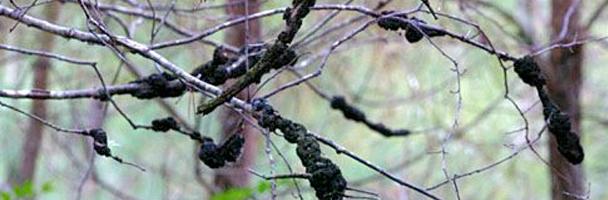
Initially, a small, olive-green gall or swelling will develop at a succulent growing point or fruit spur. This swelling will grow until it is mature, taking 2-3 years. The mature galls are hard, black, 10 to 15 cm (4 to 6 inches) and may be somewhat ruptured. Mature galls will produce and release a vast amount of spores during the bloom period, resulting in a rapid increase in infections. The fungus continues to grow internally and externally, with the branch eventually becoming girdled and dying.
How to control Black Knot?
Pruning
- Prune out all knot-bearing branches during late fall, winter or very early spring when plants are dormant and knots are easy to see.
- Remove infected branches to at least 15-20 cm (6-8 inches) below the knot. NOTE: It is preferable to prune an infected branch further back to an appropriate location, such as a healthy collar, rather than leave a stub.
- As a precaution, cutting blades should be cleaned and disinfected after pruning, if possible, especially if cuts have been made through obviously infected material.
- For knots on scaffold branches or trunks that can’t be removed, cut away diseased tissue down to good wood and at least 1 cm (1/2 inch) beyond the edge of the knot.
- Failure to remove branches beyond the internal growth will result in regrowth of the fungus.
- Diseased Wood Must Be Disposed of (burned, buried or removed from the site). Diseased knots can produce and release spores for up to 4 months after removal. Proper composting can help to accelerate the breakdown of infected materials.
Chemical Control
- Few choices available
- Not usually recommended unless for valuable plantings, such as collections, orchards, arboreta or for severe infestations.
Other Options
- May include use of more resistant selections, ensuring adequate buffer zones between plantings and wild stock, or potential employing biological control products (limited).
- Consider hiring a trained professional for pruning activities (Find a Certified Arborist).
- This information has been obtained from the Alberta Agriculture website.